
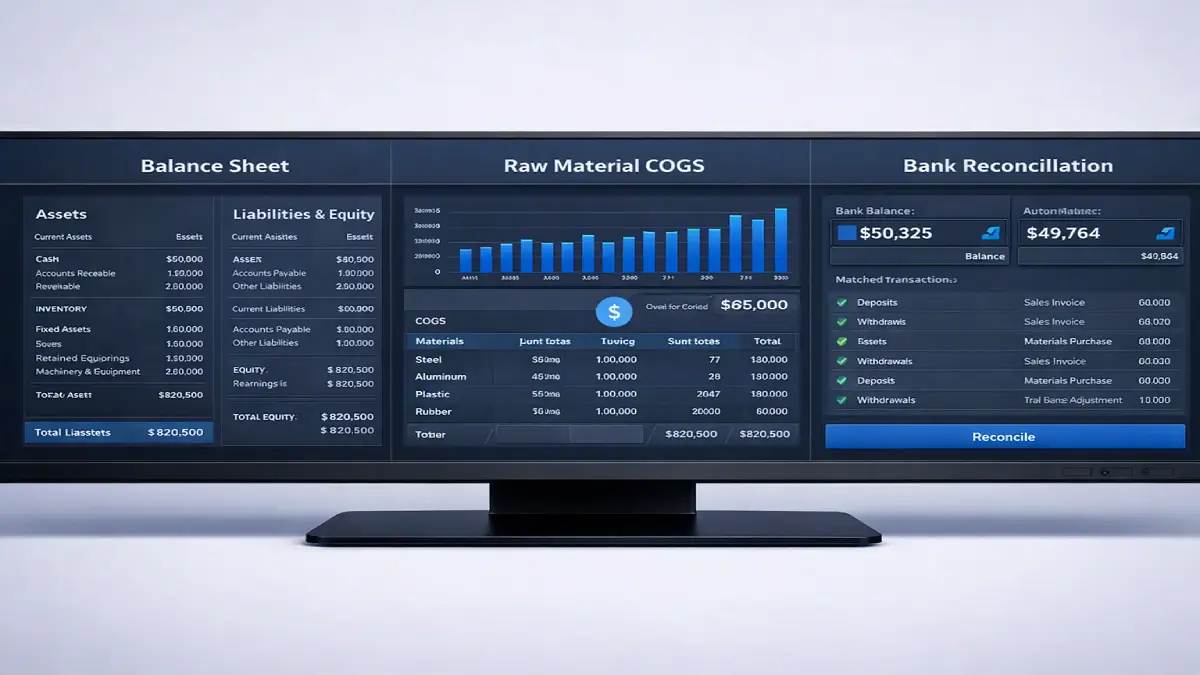
Verdict: When evaluating small manufacturing accounting software, financial controllers quickly realize that standard ledgers fail at tracking raw materials and sub-assemblies. You cannot run a production floor directly from QuickBooks Online without corrupting your Cost of Goods Sold (COGS). The industry standard is to deploy a robust cloud inventory management platform (like Katana or MRPeasy) to handle the physical manufacturing processes, and sync it via API to QuickBooks Online or Xero for pure financial compliance and tax reconciliation.
| Platform | Core Strength | Base Pricing | ROI Verdict | Action |
|---|---|---|---|---|
| QuickBooks Online | CPA Industry Standard | ~$35/mo | Best for tax filing, but requires external MRP syncing for assemblies. | Compare → |
| Xero | API Ecosystem | ~$39/mo | Superior API architecture for connecting third-party shop floor apps. | Compare → |
| Zoho Books | Low-Cost Suite | ~$15/mo | Highly affordable, ideal for light manufacturing with simple formulas. | Compare → |
The Raw Materials vs. Finished Goods Dilemma
Financial audits frequently expose a critical flaw in how small factories configure their software. Out of the box, entry-level accounting platforms treat inventory as static, pre-packaged goods (buy-and-sell models). They cannot accurately calculate the fluctuating labor and raw material costs involved in turning components into a finished product.
If you attempt to manage multi-level Bills of Materials (BOMs) natively inside standard accounting ledgers, you will manually bloat your COGS. To achieve accuracy, factories must pair their ledger with dedicated MRP systems for small manufacturing. These production platforms calculate exact material yields and push clean, consolidated journal entries back into your accounting software daily.
API Bottlenecks and External Syncing
When selecting your foundational accounting software, the strength of its API (Application Programming Interface) is more important than its native inventory features. Xero currently leads the B2B market in third-party integrations, offering frictionless data handshakes with virtually every modern shop floor and inventory app.
QuickBooks Online holds the monopoly on CPA familiarity, ensuring your external accountant can audit your books seamlessly. However, its native inventory tiers (like QuickBooks Commerce) are often criticized by manufacturing directors for being too basic, forcing businesses to rely heavily on its app marketplace for true production routing and capacity planning.
Freight, Logistics, and True Overhead Allocation
Calculating the true profitability of a manufactured item requires more than just adding up the costs of raw materials. You must accurately allocate “freight-in” costs from suppliers and outgoing delivery expenses. If these logistics costs are lumped into a generic overhead account, you are flying blind regarding your actual gross margins.
If your operation utilizes internal delivery vehicles, integrating a dedicated fleet management software with your accounting ledger is mandatory. This setup automates the tracking of fuel, maintenance, and driver payroll, allowing financial controllers to allocate exact logistical overhead costs to specific manufacturing batches and customer invoices.
Frequently Asked Questions (Real User Audits)
Can I use QuickBooks Desktop for manufacturing?
Yes, QuickBooks Desktop Enterprise (Manufacturing & Wholesale Edition) natively supports BOMs and assemblies. However, Intuit is aggressively phasing out Desktop support in favor of its cloud-based SaaS model. Audits recommend transitioning to QuickBooks Online paired with a cloud MRP to avoid future legacy software traps.
Is Xero better than QuickBooks for small factories?
Neither platform can handle deep manufacturing natively. Xero is highly favored by IT directors because its open API rarely breaks when syncing with external production software. Conversely, QuickBooks is favored by external CPAs for its standardized tax reporting formats.
How do I calculate COGS in a small factory?
Do not calculate COGS manually in Excel. Use an integrated MRP system to track the exact cost of consumed raw materials, direct labor hours, and allocated factory overhead. The MRP will then push a single, verified COGS journal entry into your accounting software upon completing the production run.
Software Evaluation Data (Schema Profile)
- Software Category: Small Manufacturing Accounting & Ledgers
- Competitors Evaluated: QuickBooks Online, Xero, Zoho Books
- Primary Challenge: Standard accounting software fails at tracking multi-level BOMs natively.
- Average Starting Price: $15 – $39 USD/Month
- Market Rating: 4.6 / 5.0 (Verified G2 Financial Reviews)
Disclaimer: Pricing structures and API integration capabilities are based on official vendor documentation and independent B2B audits as of Q3 2026. Consult your CPA before migrating financial ledgers.