
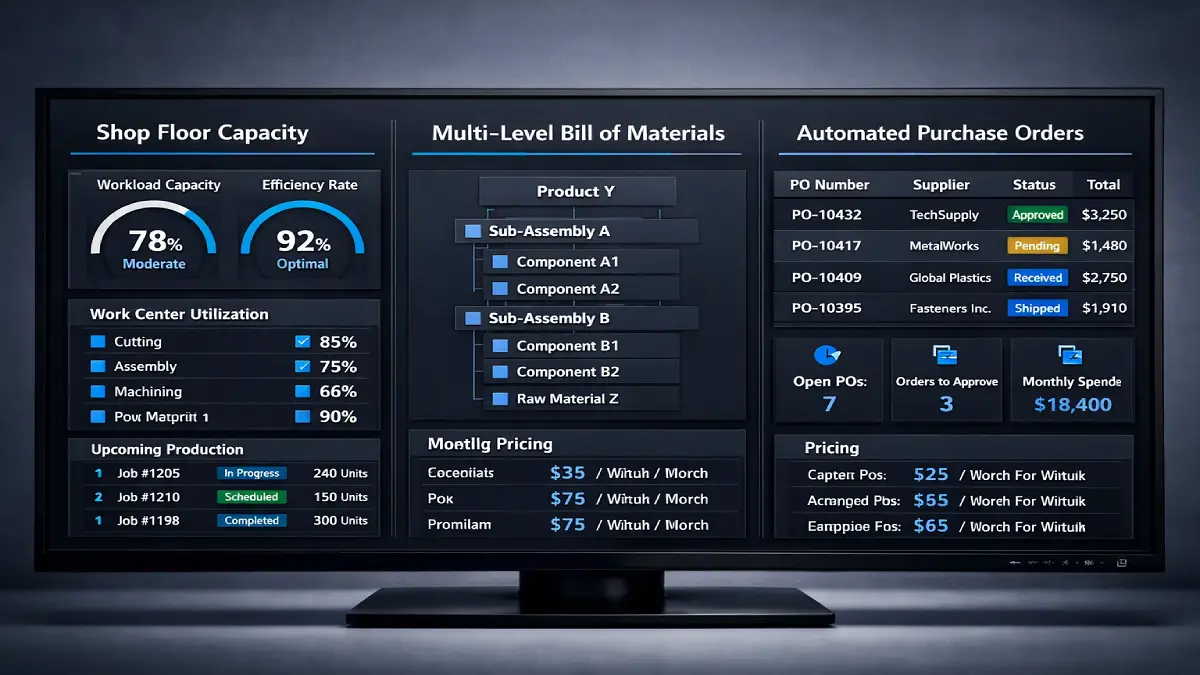
Verdict: When auditing MRP systems for small manufacturing business, operations directors must avoid legacy platforms disguised as modern SaaS. Scaling your production floor requires a robust cloud inventory management architecture capable of handling multi-level Bills of Materials (BOMs) and dynamic production scheduling. For pure assembly power without hidden paywalls, MRPeasy currently dominates the mid-market space, offering a superior Total Cost of Ownership (TCO) compared to visually focused competitors.
| Platform | Core Strength | Base Pricing | ROI Verdict | Action |
|---|---|---|---|---|
| MRPeasy | Deep Multi-level BOMs | ~$49/user/mo | Unmatched capacity for complex assemblies and sub-components. | Compare → |
| Katana MRP | Visual Shop Floor Control | ~$299/mo (Base) | Best UI for make-to-order brands with simple formulations. | Compare → |
| Qoblex | Regulated Traceability | Quote-Based | Superior lot tracking for food, beverage, and pharma. | Compare → |
Overcoming the Excel and Legacy ERP Trap
Many small manufacturers run operations on a fragile web of spreadsheets disconnected from their accounting ledgers. Transitioning to a true small manufacturing erp software eliminates the constant manual data entry that ultimately causes stockouts. However, IT audits strongly warn against over-purchasing. Legacy platforms like NetSuite or SAP Business One require massive, five-figure implementation fees and dedicated consultants.
Modern material requirements planning software offers a streamlined alternative. Platforms like MRPeasy and Katana calculate minimum order quantities (MOQs) and supplier lead times instantly against active production schedules, drastically reducing overhead while remaining affordable for shops with fewer than 50 employees.
Multi-Level BOMs and Hidden Scalability Costs
The most frequent complaint uncovered in B2B software audits involves hidden scalability costs. As explored in our deep dive on Katana MRP pricing, visual-first systems often lock essential functionality—such as barcode scanning and advanced routing—behind expensive premium tiers, punishing businesses as they scale.
For operations assembling complex physical goods (e.g., custom machinery, electronics), you require an inventory management software for small manufacturing business that natively supports infinite multi-level BOMs. MRPeasy excels in this category, allowing engineers to nest sub-assemblies inside final products without corrupting the cost-of-goods-sold (COGS) ledger.
- MRPeasy: Connects purchasing directly to production shortages. If a sub-assembly is missing a specific screw, the system automatically flags the master production schedule and generates a Draft PO.
- Katana MRP: Utilizes drag-and-drop prioritization. If you move a VIP order to the top of the queue, the software instantly reallocates available raw materials away from lower-priority jobs.
Downstream Logistics and Outbound Fulfillment
A manufacturing floor is only as efficient as its loading dock. Once the final quality check is passed, your MRP system must instantly communicate with your outbound fulfillment network. If you rely on manual CSV exports to inform dispatchers, your data is already obsolete.
For manufacturers running internal delivery fleets, connecting your production software directly to an enterprise fleet management software via REST API is mission-critical. This digital handshake ensures that inventory counts are deducted, and customer invoices are generated the exact moment the delivery vehicle leaves the yard.
Frequently Asked Questions (Real User Audits)
Can I use QuickBooks as an MRP system?
No. QuickBooks Online is strictly an accounting ledger. It cannot handle raw material consumption, waste tracking, or work-in-progress (WIP) limits. You must integrate an MRP system like MRPeasy or Qoblex to handle the physical assemblies and push automated journal entries back to QuickBooks.
Which MRP software is best for multi-level BOMs?
MRPeasy is widely regarded as the best software for deep, multi-level Bills of Materials at the small business price point. It handles complex nesting and routing significantly better than Katana’s base tiers.
What is the typical cost of an MRP for small manufacturing?
Modern cloud-based MRP systems for small manufacturers range from $49 per user/month to $399 base monthly fees. This SaaS model completely bypasses the massive $50k+ server and implementation costs historically associated with on-premise ERPs.
Software Evaluation Data (Schema Profile)
- Software Category: Manufacturing Resource Planning (MRP)
- Competitors Evaluated: MRPeasy, Katana MRP, Qoblex
- Primary Challenge: Multi-level BOM complexity & hidden tier limits.
- Average Starting Price: $49/mo (Per User) to $299/mo (Base Tier)
- Market Rating: 4.6 / 5.0 (Verified Capterra IT Reviews)
Disclaimer: BOM functionality, tier limits, and software pricing are based on official vendor documentation and independent B2B audits as of Q3 2026. Verify integration capabilities prior to deployment.