
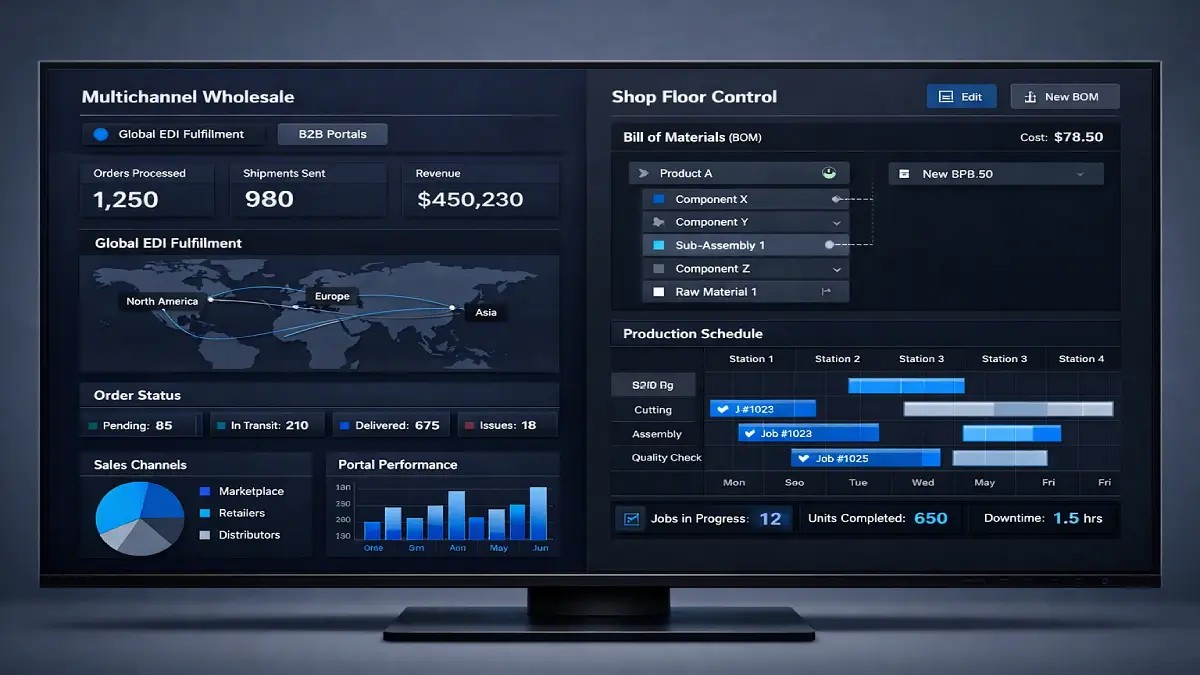
Verdict: Comparing Cin7 vs Katana is not a feature-to-feature battle; it is a fundamental choice of operational architecture. Katana MRP completely dominates light manufacturing, offering visual shop-floor control and multi-level Bills of Materials (BOMs). Conversely, Cin7 (specifically Cin7 Core) is designed for pure product sellers, offering deep native EDI integrations and cloud inventory management for multichannel wholesalers scaling aggressively across Amazon FBA and Shopify.
| Platform | Core Architecture | Base Pricing | ROI Verdict | Action |
|---|---|---|---|---|
| Katana MRP | Manufacturing (Make-to-Order) | ~$299/mo (Usage-based) | Best for in-house production and assembly scheduling. | Verify Pricing → |
| Cin7 Core | Wholesale & Multichannel | ~$349/mo (Tiered) | Superior for B2B portals and EDI routing. | Compare → |
Manufacturing vs Multichannel Routing
Katana is engineered entirely around production visibility. Its drag-and-drop dashboard allows operations managers to instantly re-prioritize manufacturing tasks based on real-time raw material availability. If an essential component is delayed, Katana automatically flags the affected sales orders in red. As detailed in our deeper technical breakdown of Katana vs Unleashed, this material requirements planning (MRP) logic is unmatched for its price point.
Cin7, while offering basic assembly features, treats manufacturing as an afterthought. Its primary strength lies in its native B2B portal and robust Electronic Data Interchange (EDI) capabilities. If your business model involves routing pre-manufactured goods to big-box retailers (like Target or Home Depot) or managing 3PLs via complex API mapping, Cin7 handles high-volume commercial constraints far better than Katana.
Hidden Costs, API Bottlenecks, and Support
Independent IT audits reveal severe differences in vendor reliability. Katana boasts excellent onboarding and highly responsive customer support. However, Katana’s pricing model strictly limits the number of sales orders per month on its base tiers. Fast-growing D2C brands often hit these volume ceilings quickly, forcing premature and expensive subscription upgrades.
Cin7 suffers from the opposite problem: severe post-acquisition technical debt. User reviews consistently expose Cin7’s customer support as outsourced and slow to respond to critical API integration failures. Furthermore, merchants frequently report rigid reporting structures and undocumented price hikes on renewal contracts.
- Data Mapping Issues: Cin7 occasionally struggles with basic API hygiene, such as forcing users to map SKUs manually when switching between Amazon FBA and FBM fulfillment.
- Onboarding: Katana users can often self-onboard using native tutorial libraries. Cin7 almost exclusively requires hiring a certified implementation partner to ensure Xero or QuickBooks ledgers balance correctly.
Fulfillment and Logistics Connectivity
When stock leaves your warehouse, the ERP must communicate flawlessly with downstream logistics providers. Both platforms integrate with standard tools like ShipStation. However, operations relying on specialized fleet management software or internal delivery trucks will find Katana’s webhooks slightly easier to customize for shop-floor to loading-dock handoffs.
Cin7 connects natively to global 3PL networks, but modifications to those connections often require paid custom development. Operations directors must demand a proven integration sandbox before signing an annual contract with either vendor.
Frequently Asked Questions (Real User Audits)
Does Katana integrate well with Shopify?
Yes. Katana’s Shopify integration is highly stable. When an order is placed on Shopify, Katana immediately commits the finished goods or triggers a manufacturing order if the item is out of stock, keeping both platforms perfectly synced.
Why do users complain about Cin7 customer support?
Audits of user feedback indicate that Cin7’s support relies heavily on scripted offshore teams. Complex technical issues, such as API connection errors with EDI partners or Xero sync failures, often take days to escalate to a knowledgeable engineer.
Which platform is better for pure B2B Wholesale?
Cin7 Core wins decisively. It includes a native B2B portal that allows your wholesale clients to log in, view custom tier-pricing, and place bulk orders directly. Katana lacks this functionality natively and requires third-party workarounds.
Software Evaluation Data (Schema Profile)
- Software Category: Cloud Inventory & MRP Software
- Comparison Target: Cin7 Core (Wholesale) vs Katana MRP (Manufacturing)
- Katana Core Limitation: Usage-based pricing caps on monthly sales orders.
- Cin7 Core Limitation: Poor support response times and forced UI bloat.
- User Satisfaction: Katana (93%) vs Cin7 (84%) (SelectHub Data)
Disclaimer: Pricing, API limitations, and support metrics are based on official vendor documentation and independent IT audits as of Q3 2026. Review exact volume thresholds prior to deployment.